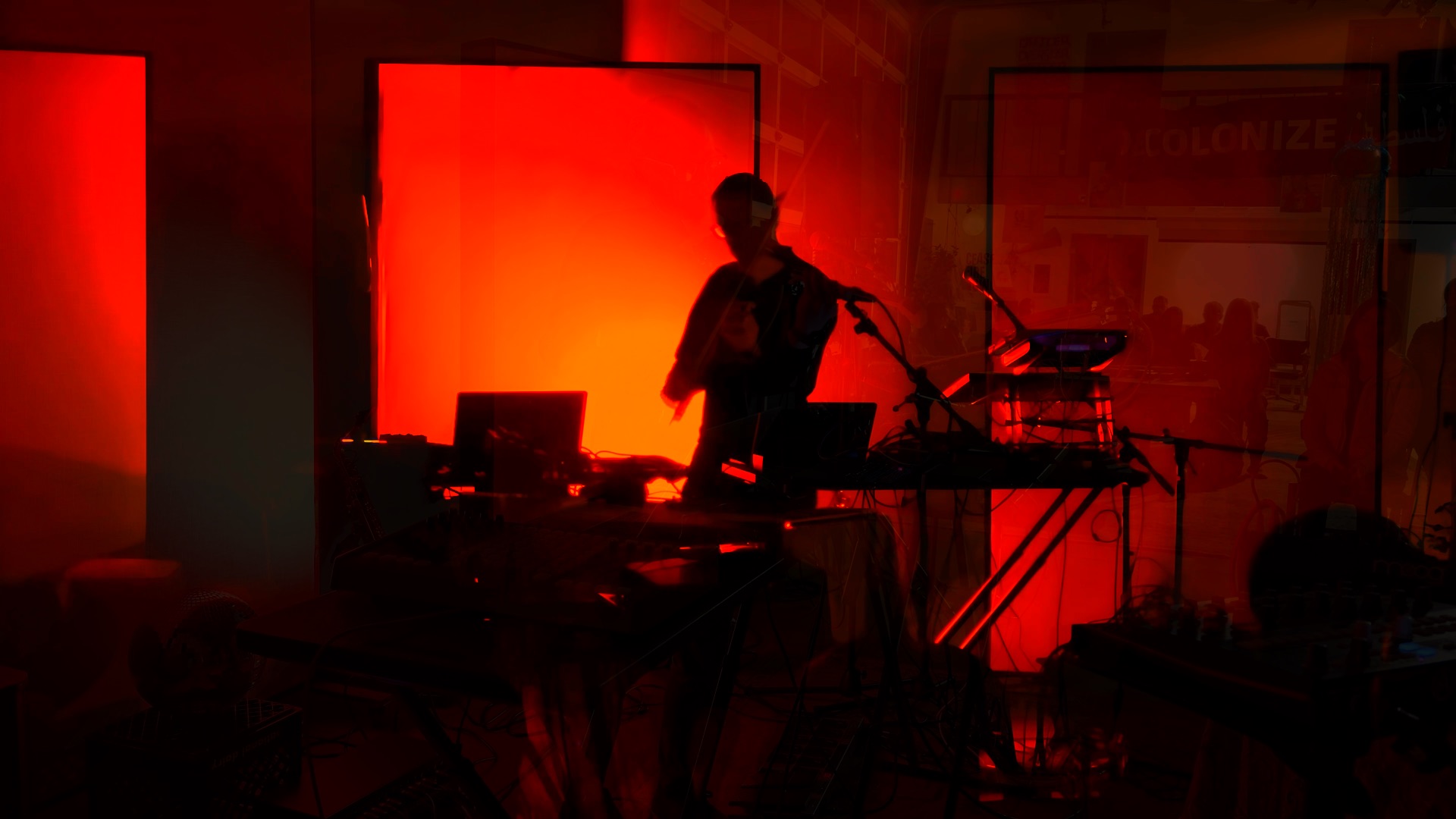
Knitting
for the EV and RAVE neural synthesis AI model, premiered at the 2025 Technosonics Festival
The EV is an augmented viola-like instrument developed as a platform for exploring how the gestural nuance of acoustic string performance can drive the expansive potential of digital synthesis—time- and frequency-domain processing, machine learning, and human-computer interaction.
The instrument is custom-built, comprising a physical body, analog circuitry, and a synthesis engine coded in C++ (EV 3) and Pure Data and Python (EV 2.5). The software consists of a scalable architecture designed to accommodate various custom modules, including classic and novel synthesis techniques such as modulation synthesis, FFT convolution, physical modeling, granular processing, feature extraction, and ambisonic spatialization, as well as AI synthesis applications such as neural synthesis and non-negative matrix factorization (NMF). The most recent iteration, EV 3, runs on embedded Bela single-board computers housed within a CNC-machined wooden body and configured remotely using a mobile interface—a fully realized embedded real-time system where human-computer interaction and interface design are central.
EV 3 was a finalist in the 2026 Guthman Musical Instrument Competition (Georgia Tech) and EV 2 was a semi-finalist in the 2022 Guthman Musical Instrument Competition. The composition two tales from the shadows of the grid, composed with the EV, won first place at the IEEE Big Data 2025 AI Music Competition (AIMG 2025).
Lindgren’s research on the EV has been published in Organised Sound, examining spatial digital instrument design and situating the instrument within broader conversations about embodiment and virtuality in contemporary computer music.
The EV has been featured in Popular Science, Wired, and Gizmodo. Press descriptions include: “a computer disguised as fine lutherie” (Popular Science) and “a true blend of the acoustic and digital” (Wired).
The EV has been performed at:
The EV has been presented at:
The EV has evolved through an iterative development process, with each version addressing specific challenges while building toward a robust platform for exploring digital-acoustic sound. The instrument emerged from a desire to create an electronic musical instrument for string players that retained the sense of embodiment and detailed nuance of sound generation that string players are accustomed to.
EV 1 began as a retrofitted acoustic viola, serving as an initial foray into the project. Using conductive sensors embedded in the fingerboard to track finger position and a custom quadrophonic pickup, it successfully demonstrated the creative potential of convolving acoustic and synthesized signals. The studio album Etudes & Vignettes marked a pivotal juncture in EV 1’s development, proving its potential for the composition and synthesis of compelling new digital-acoustic sound. The album NUAGES represented another important milestone, functioning as a studio composition that further explored the instrument’s timbral palette. EV 1 was later exhibited at The STEAM Engine at Rhizome DC in December 2025. Despite these successes, EV 1 faced significant limitations: pitch data would drift over time, electrical connections were unreliable, and persistent crosstalk between strings hindered performance.
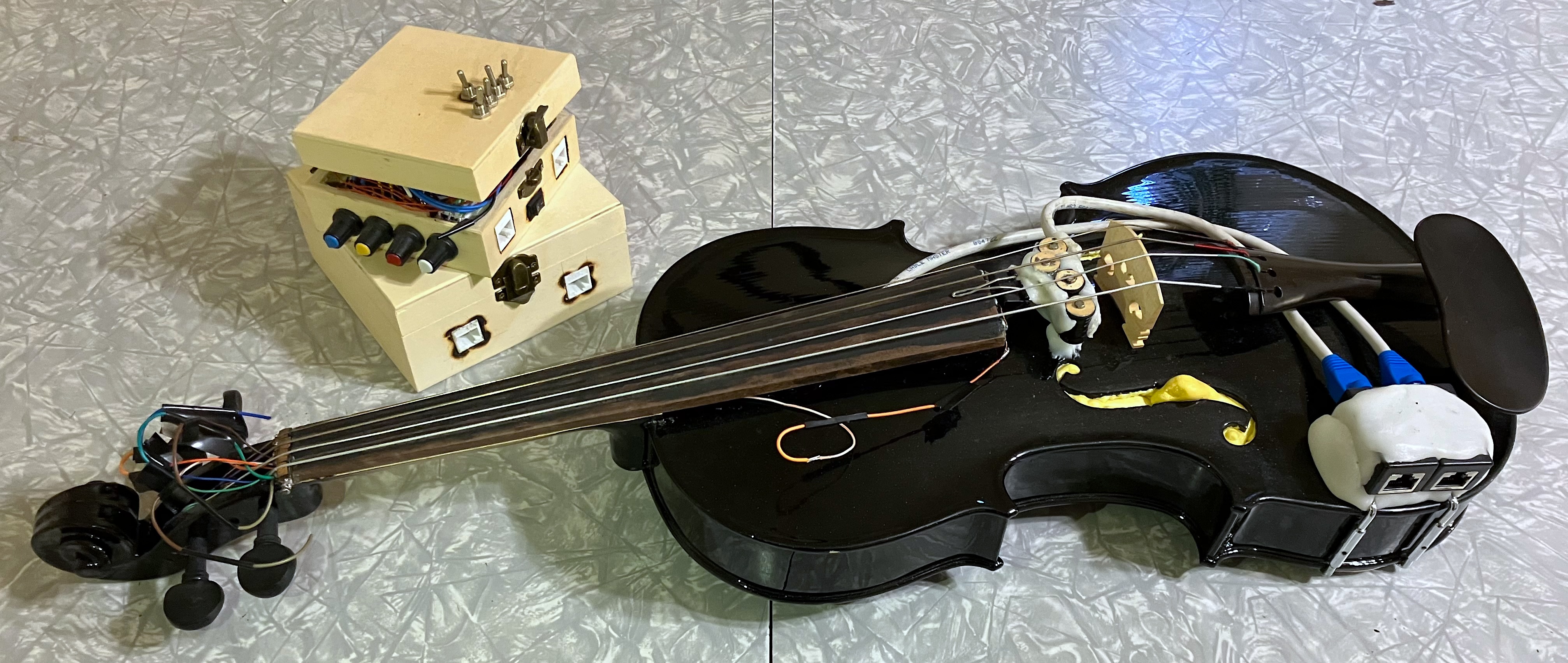 EV 1 with external boxes housing a quad preamp & Arduino Mega for ADC
EV 2 embraced digital fabrication with a custom 3D-printed body designed in Autodesk Fusion 360, incorporating a carbon fiber rod for structural reinforcement. The adoption of printed circuit boards and a Bela single-board computer (offering 16-bit resolution at 22.05 kHz) dramatically improved reliability. A custom infrared pickup was designed to eliminate crosstalk, and conductive PLA strips replaced the earlier graphite mixture. EV 2’s increased stability led to its presentation at the NIME 2022 conference and its recognition as a semi-finalist at the 2022 Guthman Musical Instrument Competition. This newfound stability also enabled pandemic-era performances such as the Experimental Sound Studio Quarantine Concerts and created room to experiment with other media, resulting in Wall of Doubt, which uses control data from the instrument to control a GPU shader. While EV 2 represented major progress—becoming stable enough for live performance with noticeably reduced latency—new challenges emerged: string-to-sensor contact remained inconsistent, neck flexion affected the action, and crosstalk persisted.
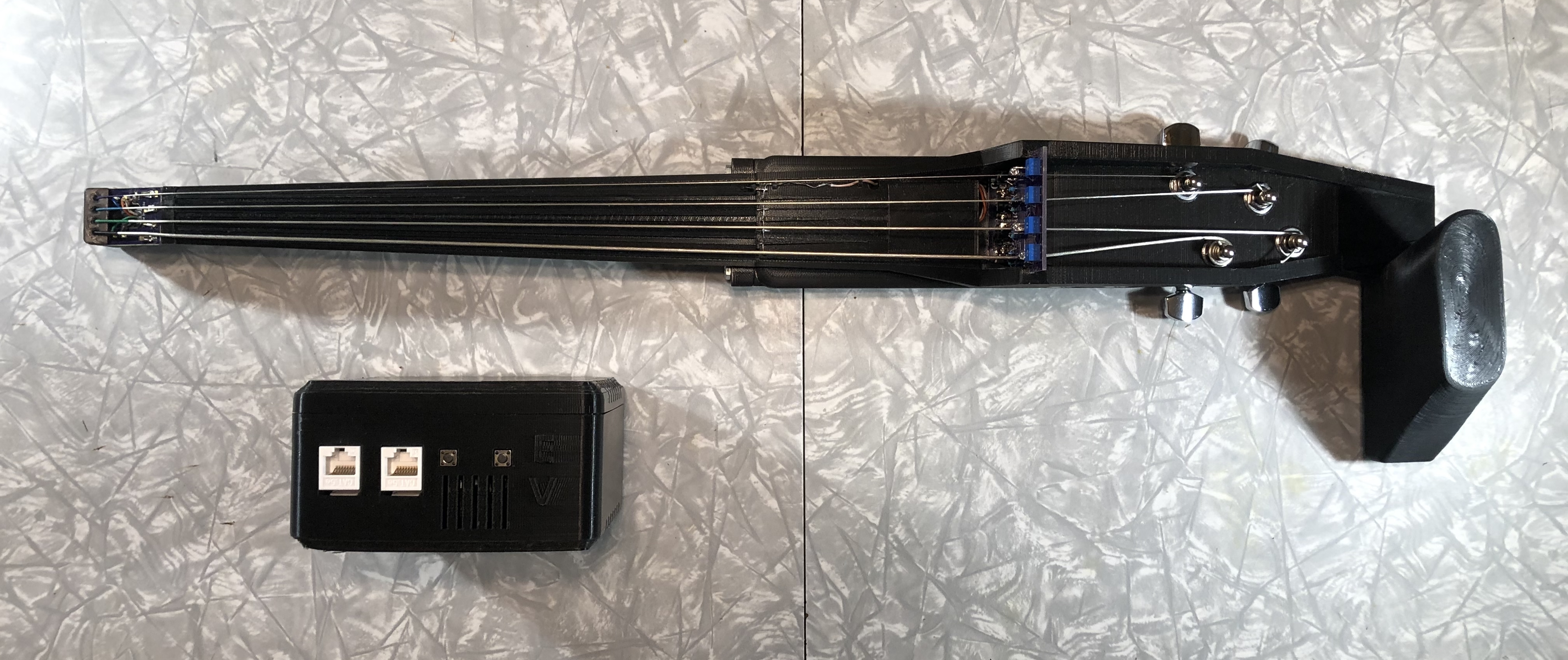 EV 2 with external box housing a quad preamp & Bela single board computer for ADC
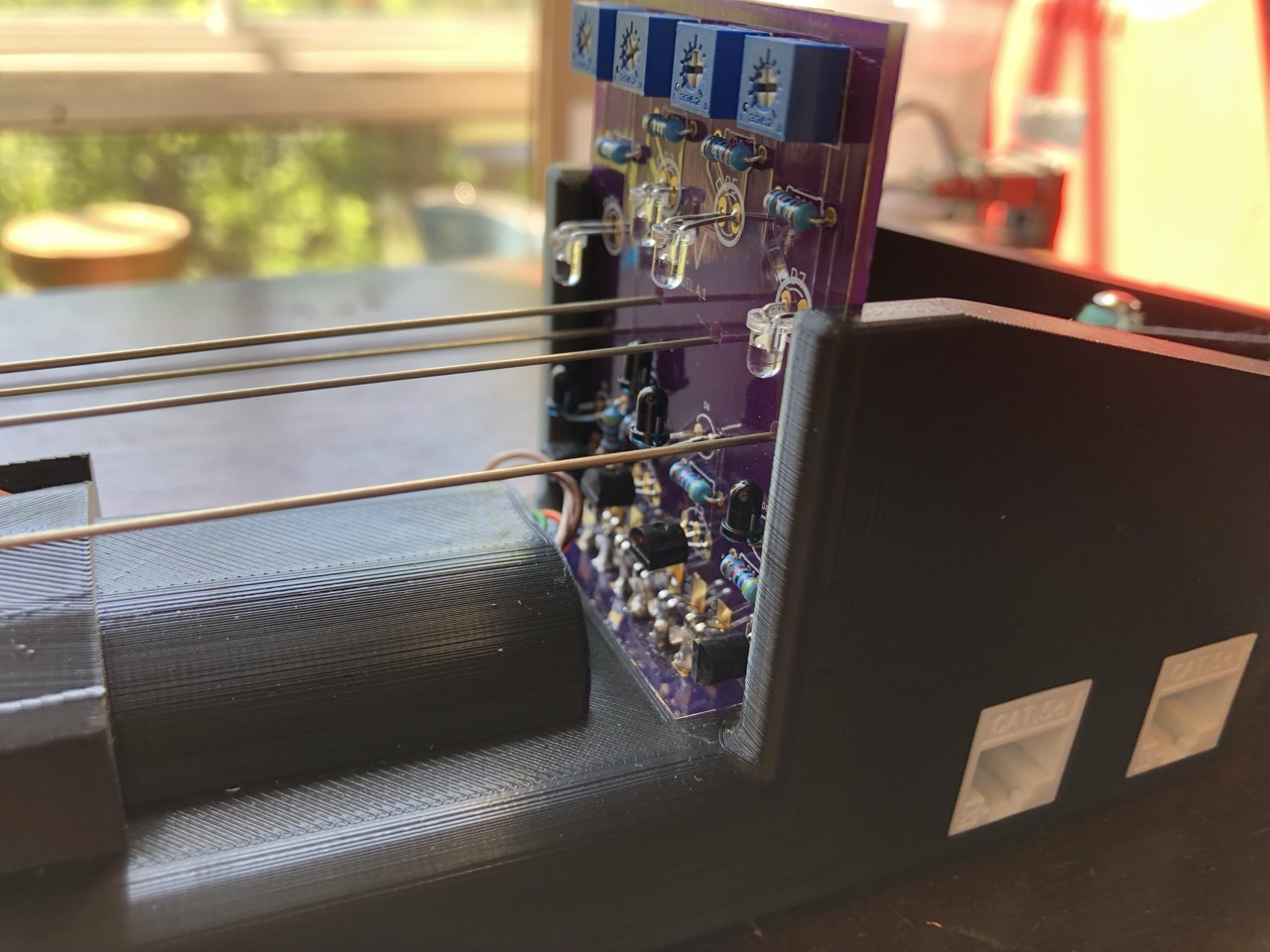 EV 2 quad IR pickup
EV 2.5 refined the design with tough PLA for increased stiffness and a more robust carbon fiber support structure. The breakthrough came with conductive rubber strips that could “hug” the string, improving electrical contact. The crosstalk issue was finally resolved by switching from a hex inverter to an op-amp design, and adjusting the infrared pickup angle to 60 degrees dramatically reduced the noise floor. A major advancement was the implementation of zero-crossing pitch detection, eliminating calibration needs and rendering the conductive strips obsolete. The software expanded considerably, adding third-order ambisonic spatialization, a preset system with 396 parameters per string, grain delay, buffer freeze effects, and multichannel processing across six cores. The further refinements of EV 2.5 allowed Etudes & Vignettes to be performed live at the SEAMUS conference and provided the flexibility to begin experimenting with ambisonic spatialization as part of the instrument’s synthesis palette, resulting in the composition Daughter of the Stars, premiered at EMPAC at the International Conference on Auditory Display. This work is detailed in the Organised Sound article “Exploration of Spatial Composition with a New Electronic Stringed Instrument”. The solidification of the Pure Data architecture in EV 2.5 is documented in “An Augmented String Instrument Architecture Created with Pure Data”, presented at PdMaxCon25~. This more robust palette has allowed for the continued expansion of the instrument, including the RAVE neural synthesis variational autoencoder, demonstrated at the NeurIPS 2025 Music and AI Workshop. With latency reduced to 27ms and reliable stage performance achieved, EV 2.5 realized the vision first imagined in EV 1.
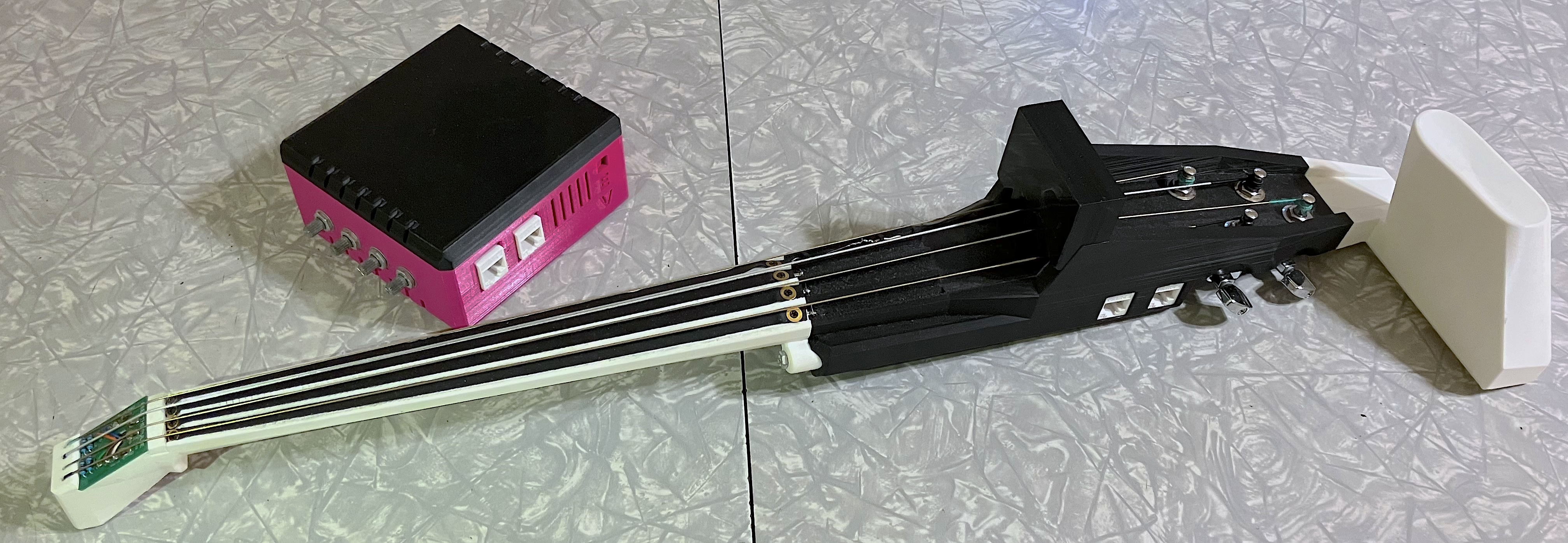 EV 2.5 with external box housing a quad preamp & Bela single board computer for ADC
EV 3 is a self-contained instrument with four Bela Minis providing onboard processing (one per string), eliminating the need for a laptop. The body has been CNC-machined from curly maple rather than 3D-printed plastic, offering a smooth neck surface and superior structural integrity. Improvements include sub-2ms latency and enhanced signal-to-noise ratio through the use of delta-sigma converters. The software has been ported to an efficiency-oriented C++ version to maximize the embedded platform’s capabilities. EV 3 was featured in the 2026 Guthman Musical Instrument Competition at Georgia Tech in March 2026.
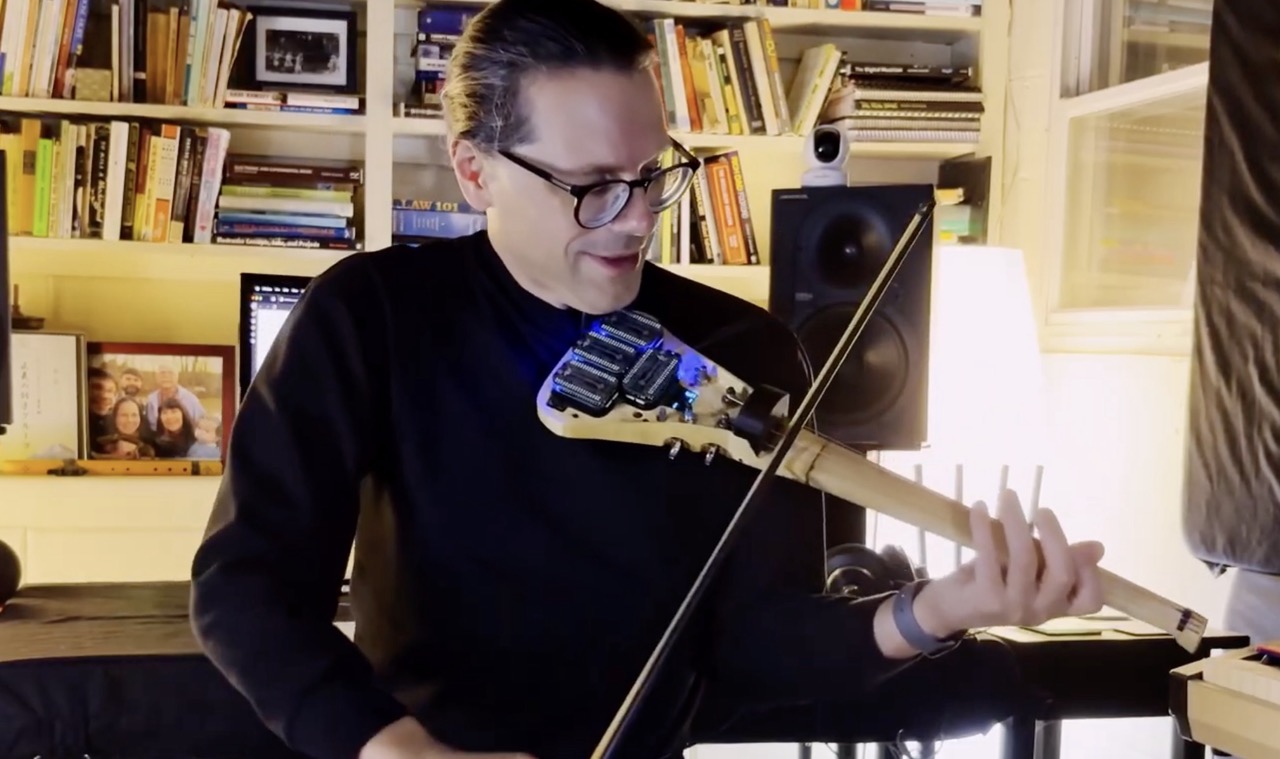 EV 3 featuring a CNC-cut curly maple body and 4 Bela minis for onboard processing
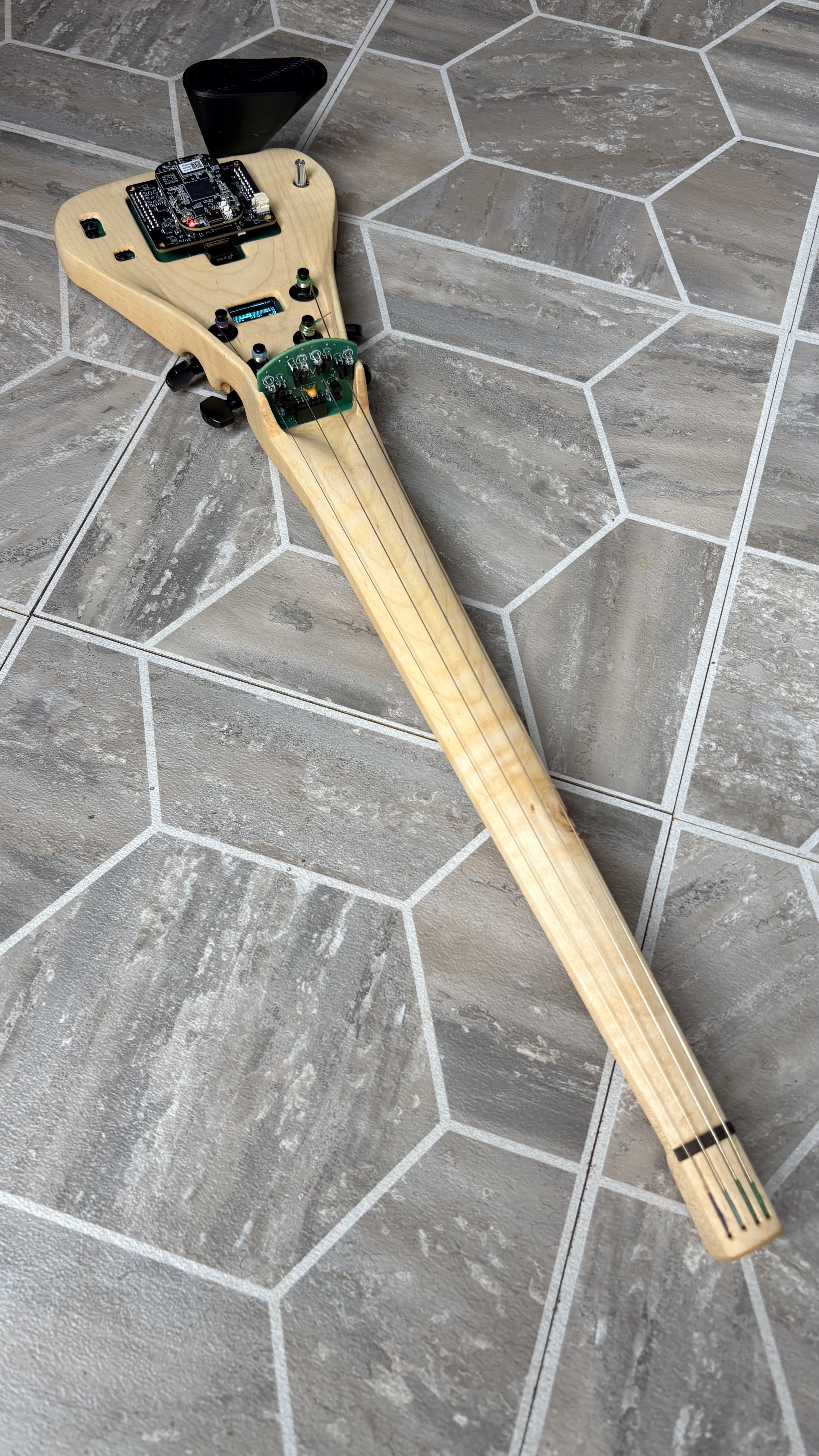
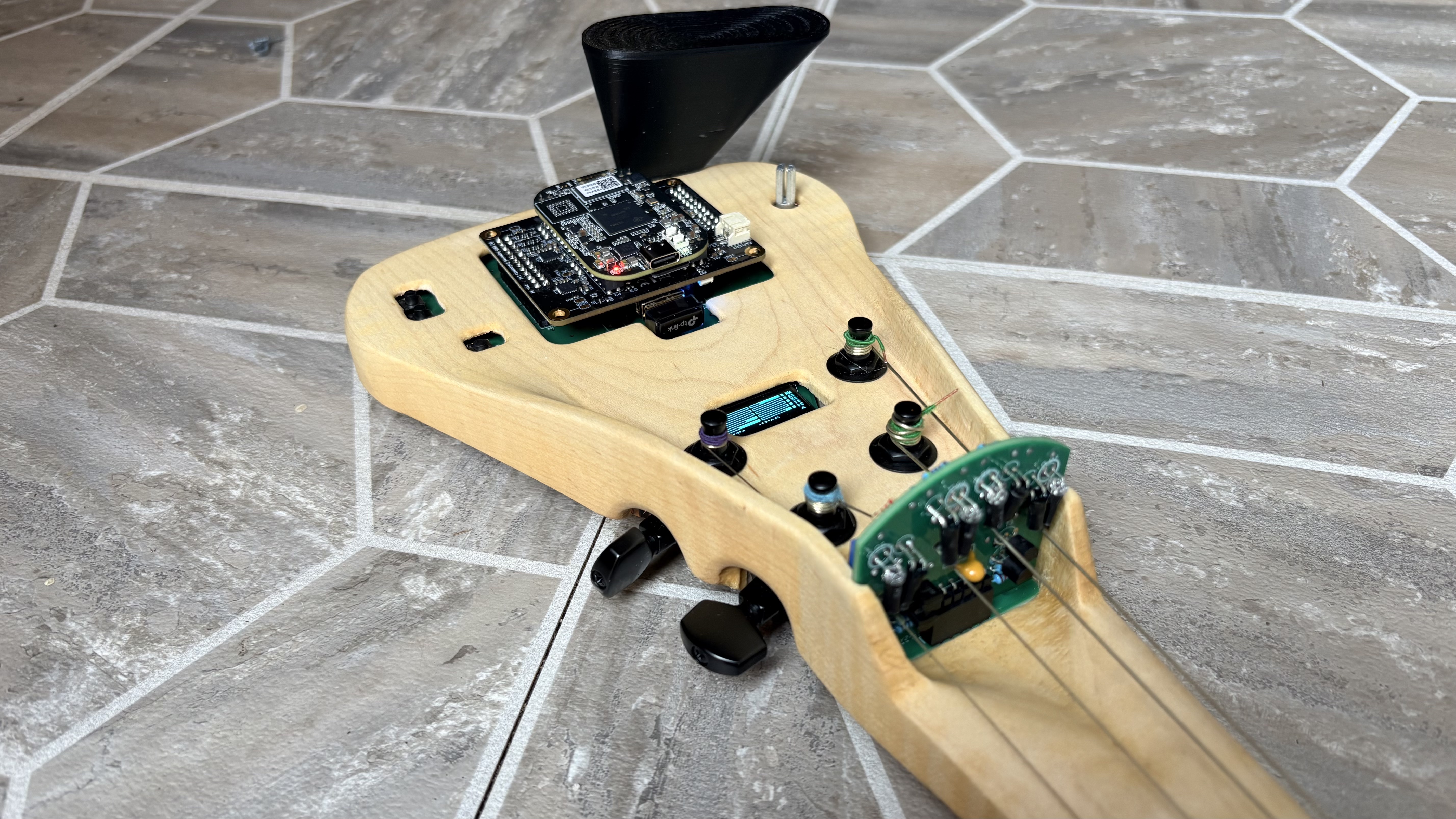
EV 3.5 represents the most significant architectural consolidation in the instrument’s development. Where EV 3 ran four discrete Bela Mini computers—one per string—the 3.5 replaces that distributed stack with a single Bela Gem, a quad-core ARM processor that preserves the one-core-per-string model in a dramatically more integrated package. A redesigned 4-layer PCB with separated analog and digital power domains, dedicated low-noise regulation, and EMI shielding throughout yields a substantially cleaner noise floor.
On the software side, eliminating the four-board UART architecture removes the synchronization complexity and fragile physical interconnect of previous versions, with all processing now unified in a single codebase running on the Gem’s four cores in parallel. Both the browser-based WiFi GUI and the instrument-mounted OLED display have been substantially refined in this version. The OLED now presents a compact heads-up layout—preset number and name, CPU load, and battery voltage across the top, with per-string and main mix VU meters below, including a gain reduction meter that tracks the output limiter. Both interfaces stay in sync bidirectionally: recalling a preset from the hardware buttons updates the GUI automatically, and the OLED reflects the current state at all times via a lock-free pipe from the audio thread.
for the EV and RAVE neural synthesis AI model, premiered at the 2025 Technosonics Festival
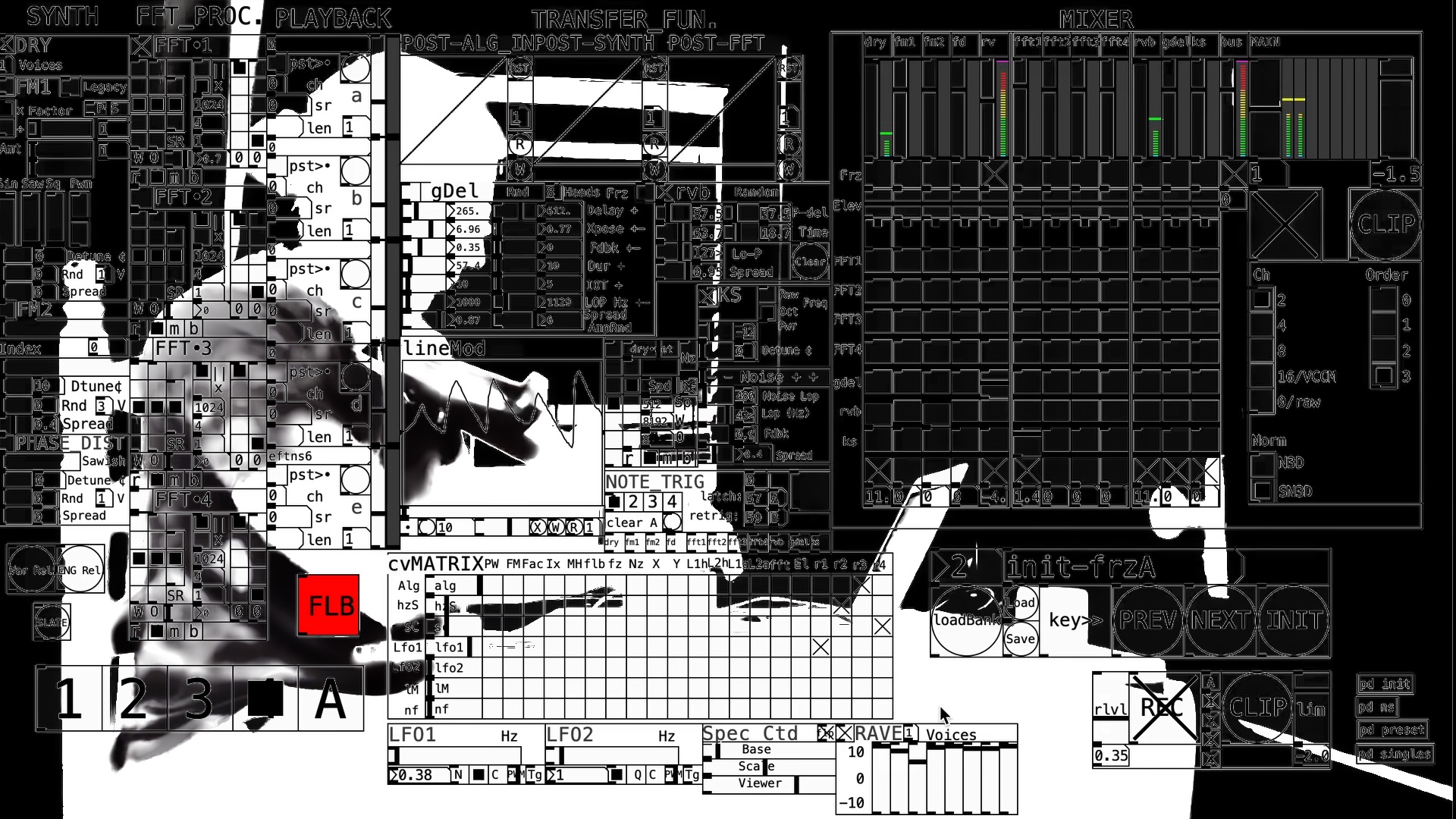
First Place, IEEE Big Data 2025 3rd Workshop on AI Music Generation: AI Music Competition (AIMG 2025)
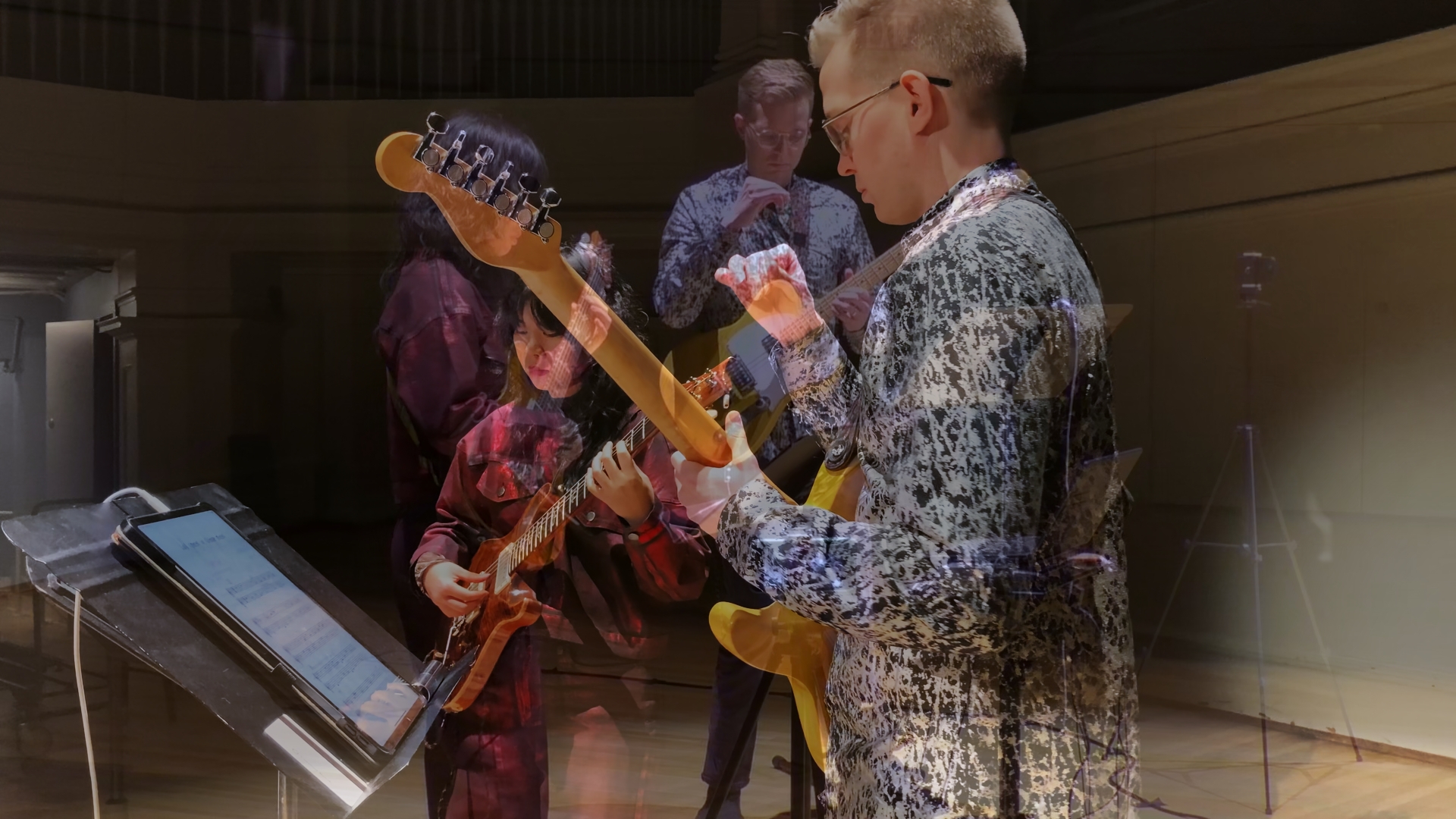
for guitar deo, premiered by LINÜ: Gulli Björnsson and Jiji
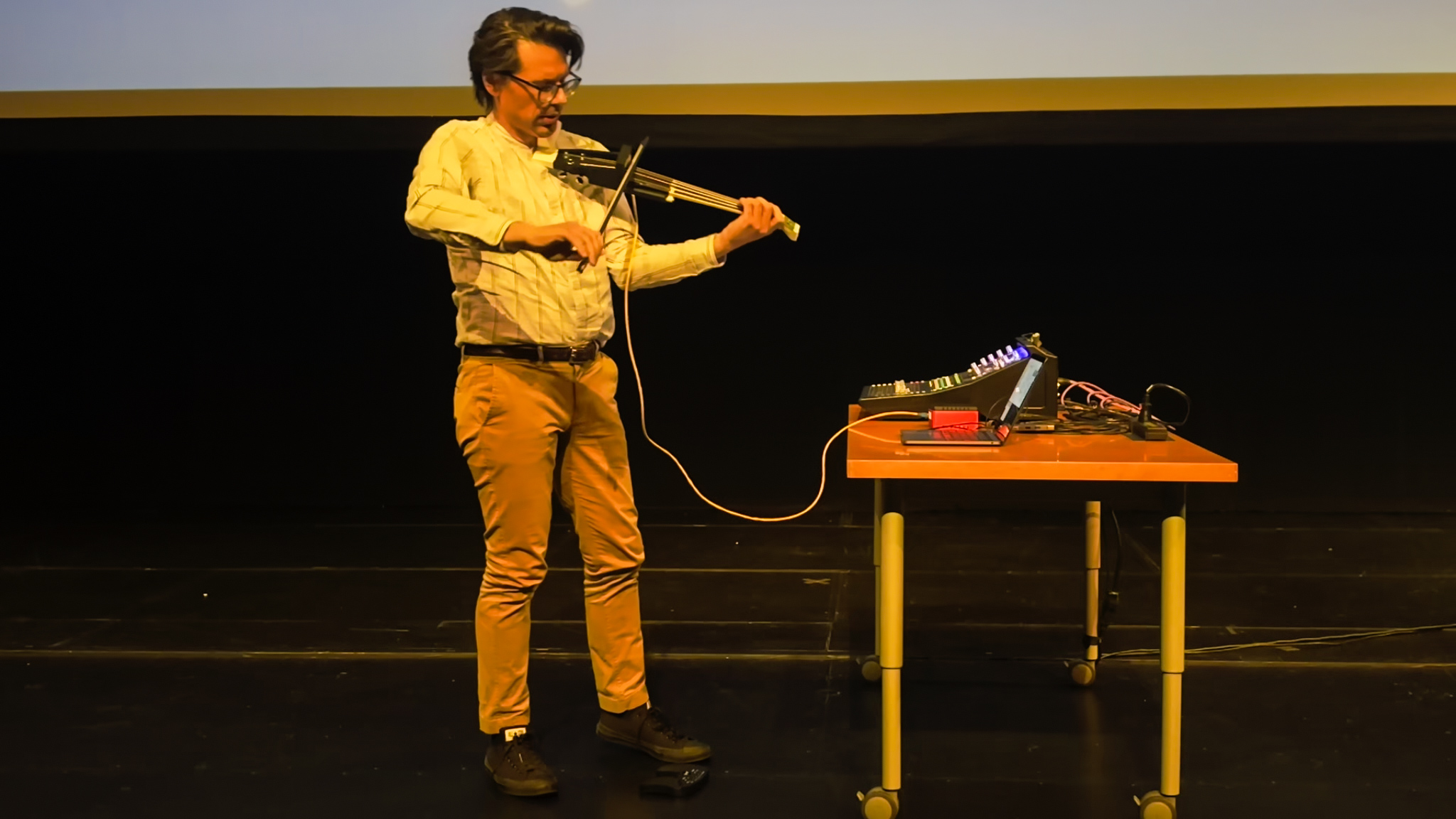
premiered at EMPAC (Troy NY) at the 29th International Conference on Auditory Display (ICAD)
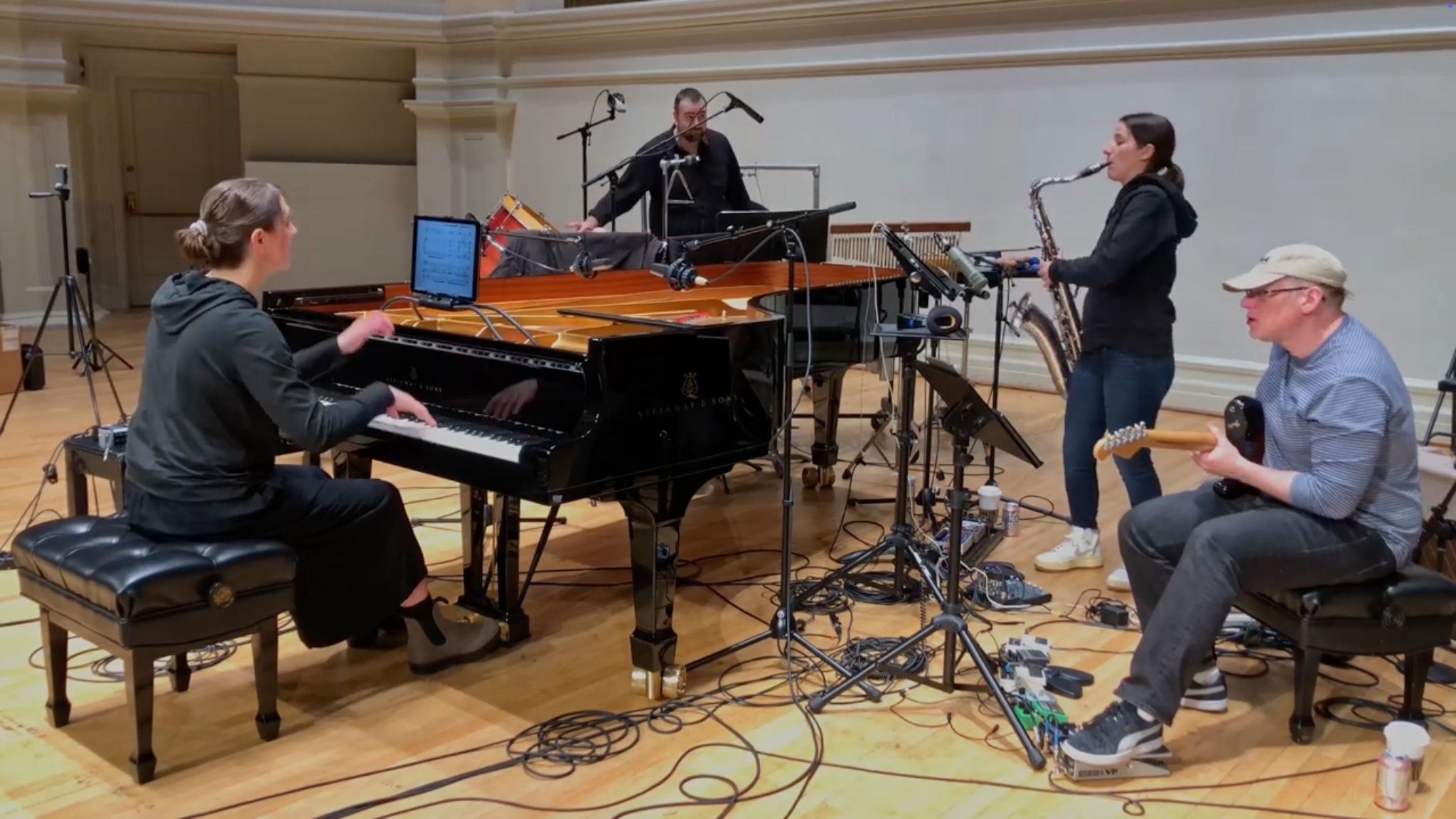
for processed saxophone, guitar, piano, and percussion, premiered by HYPERCUBE

EV recordings
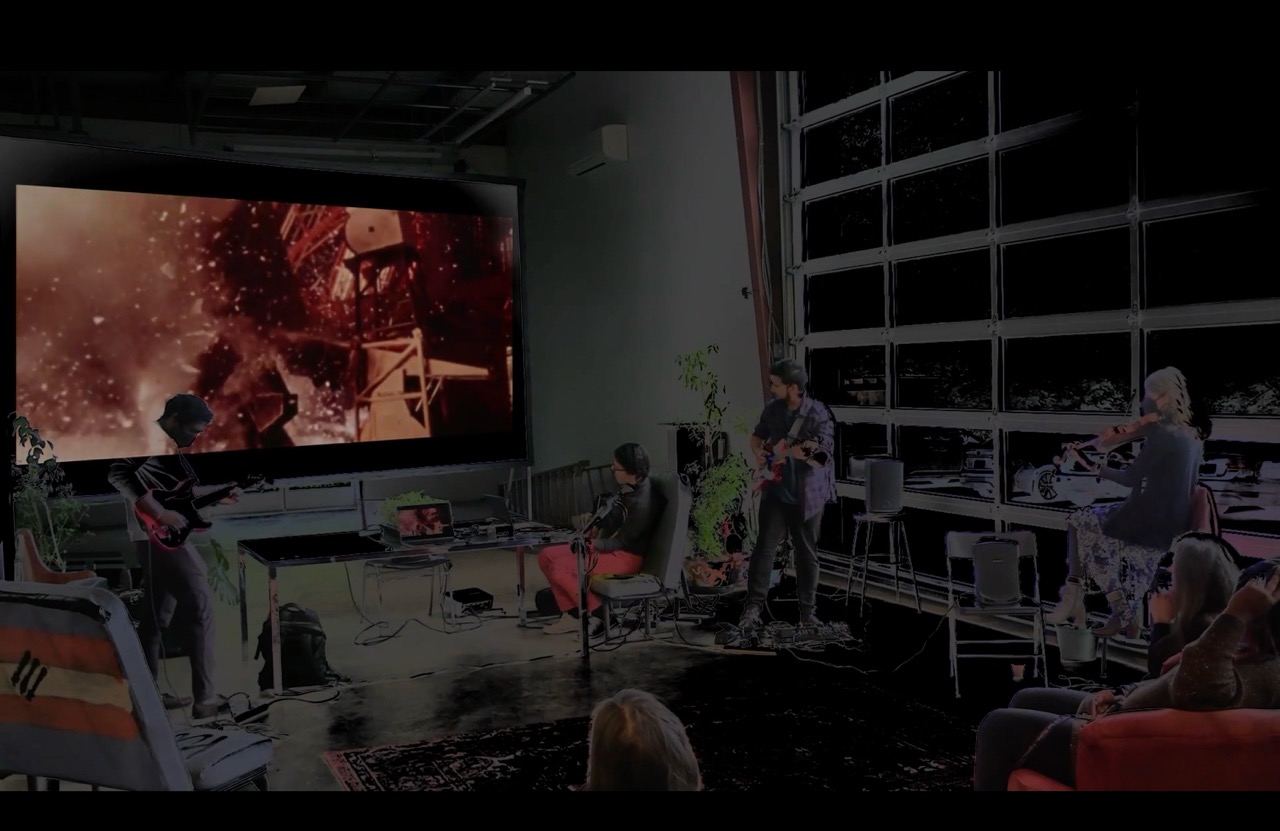
Live ensemble improvisation at Visible Records
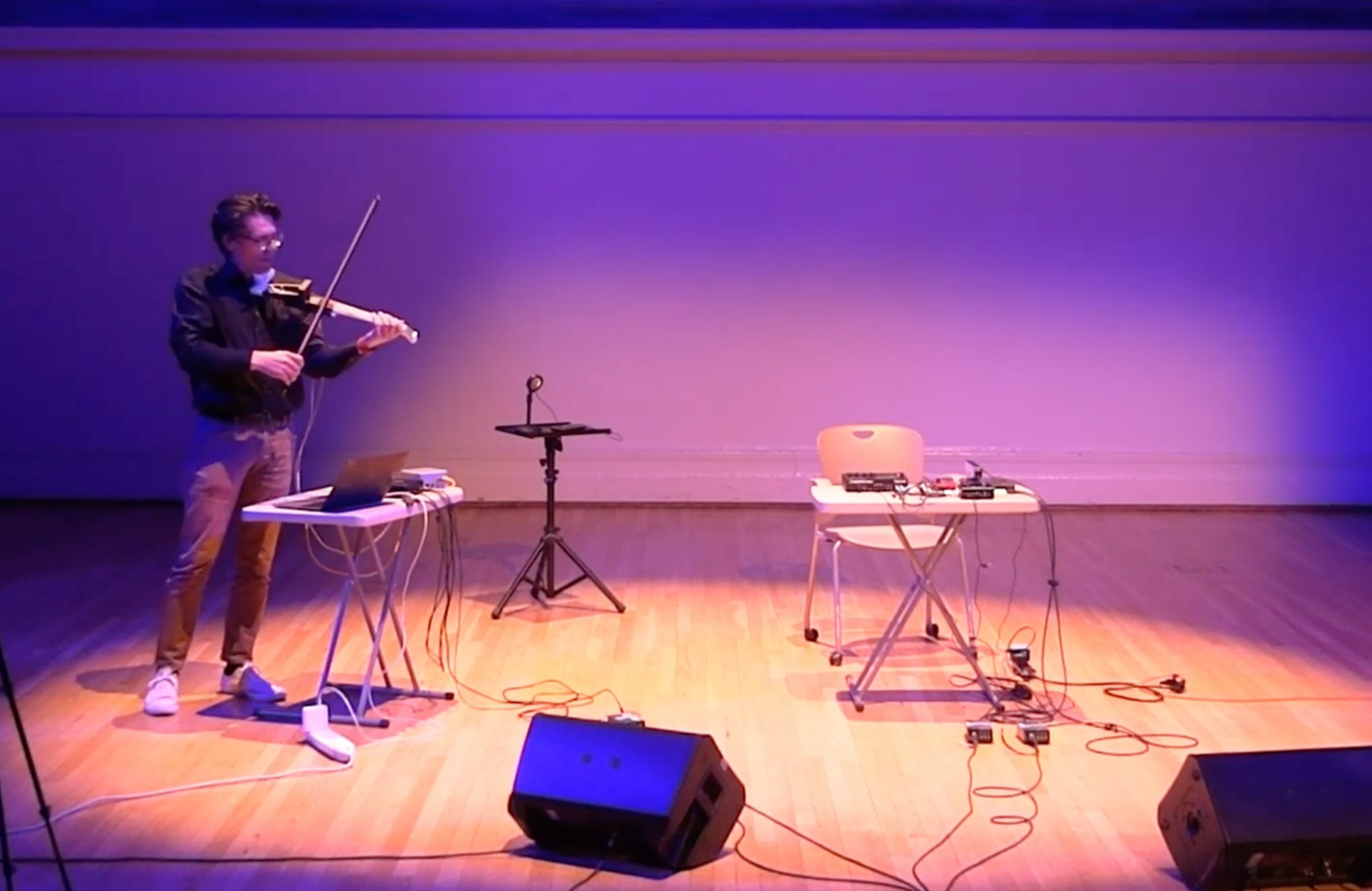
premiered at the Digitalis Festival, Old Cabell Hall
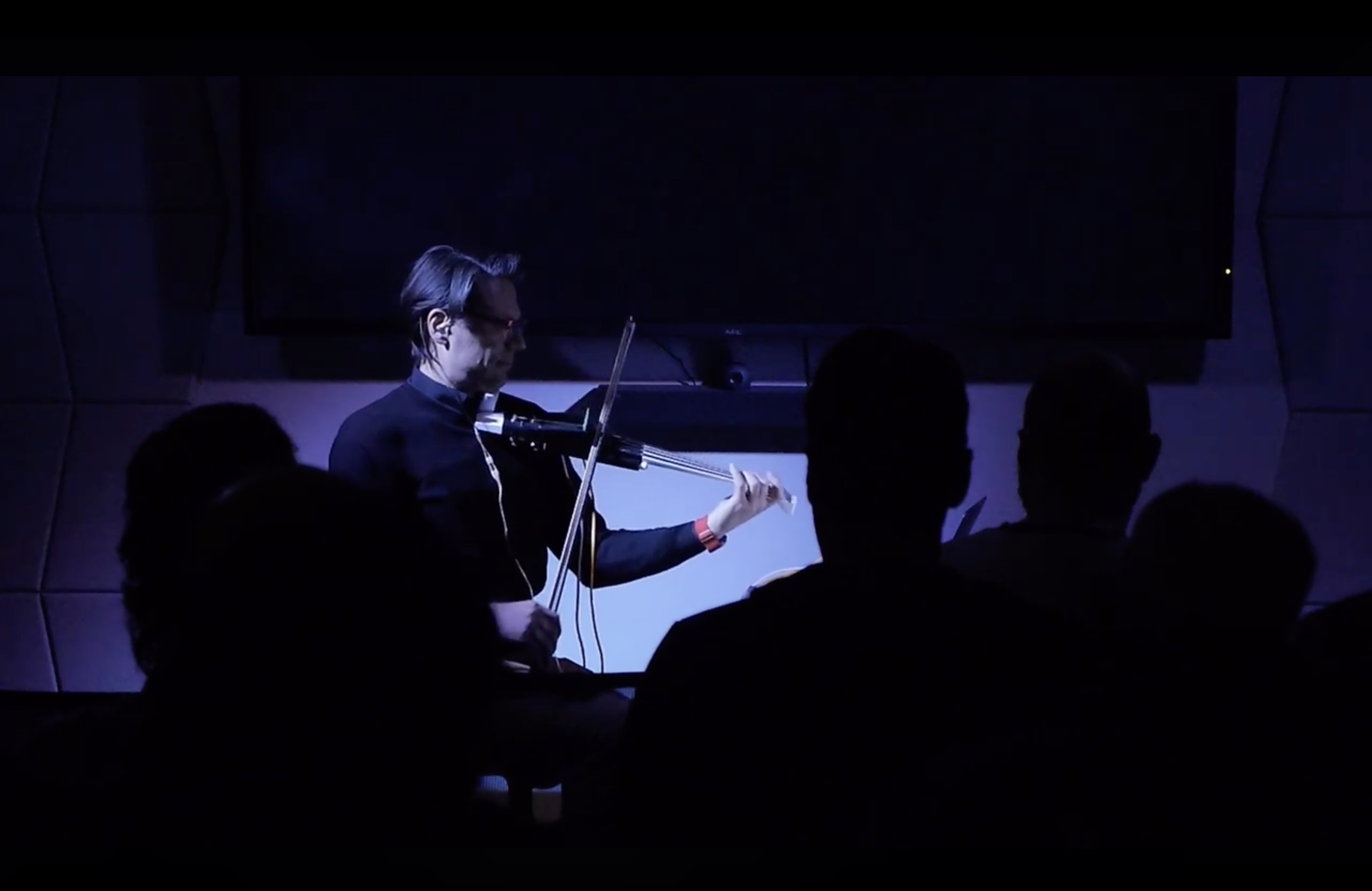
live performance with EV 2.5 at the SEAMUS Conference (NYU Feldstein Immersion Room)
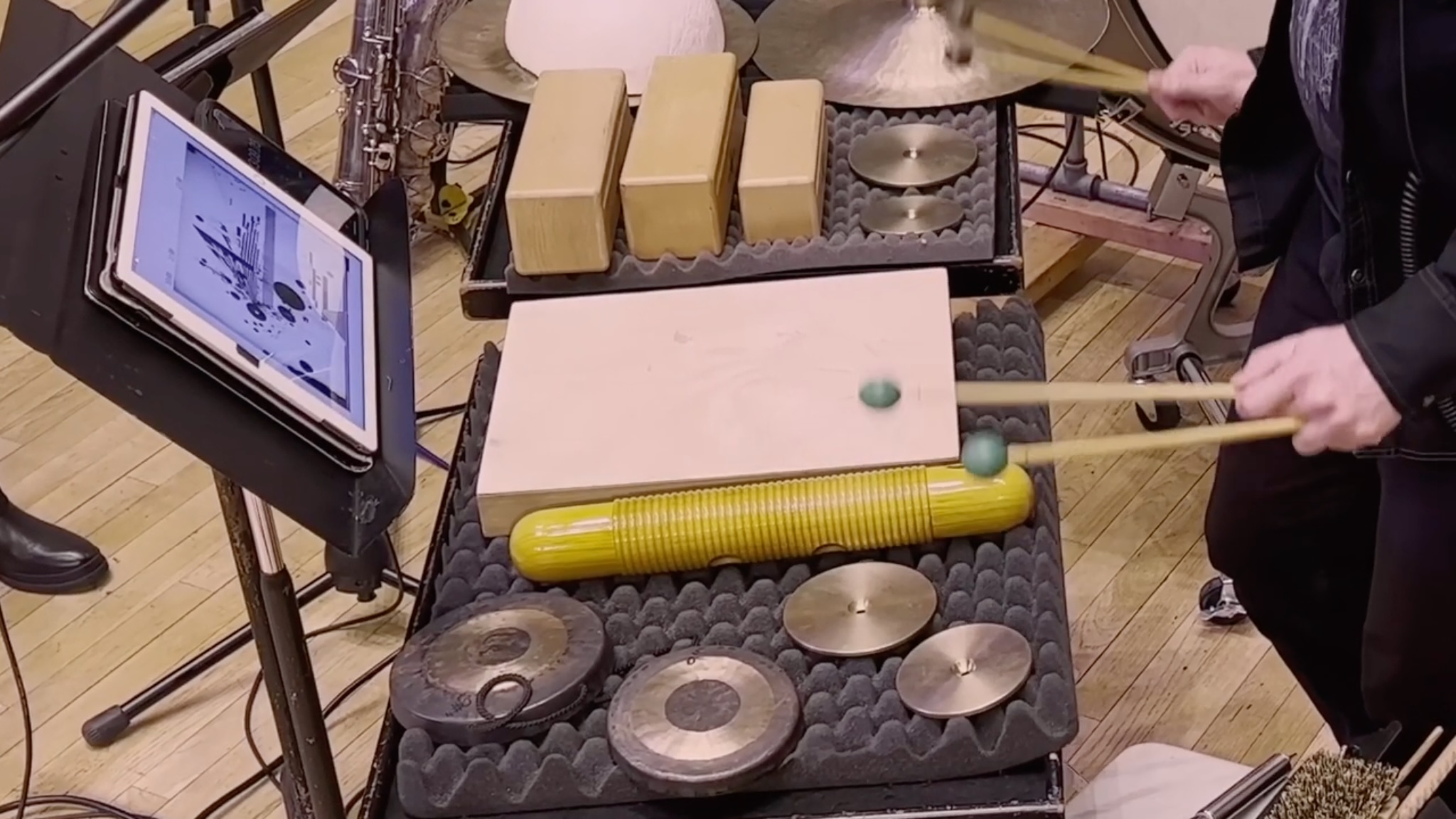
for Saxophone, Percussion, and Electronics, premiered by Popebama
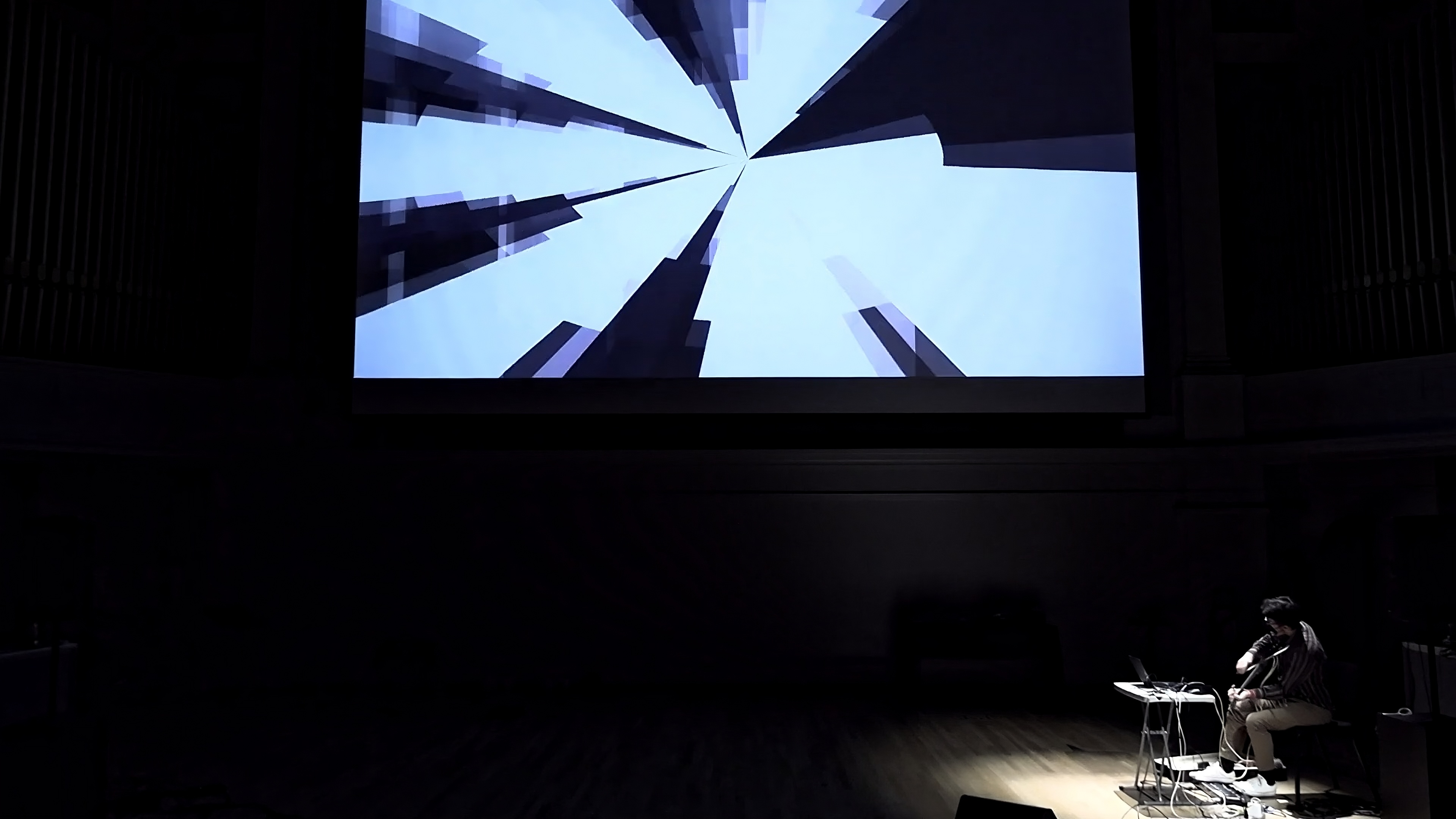
premiered at the 2022 Digitalis Festival, for the EV and GPU shader
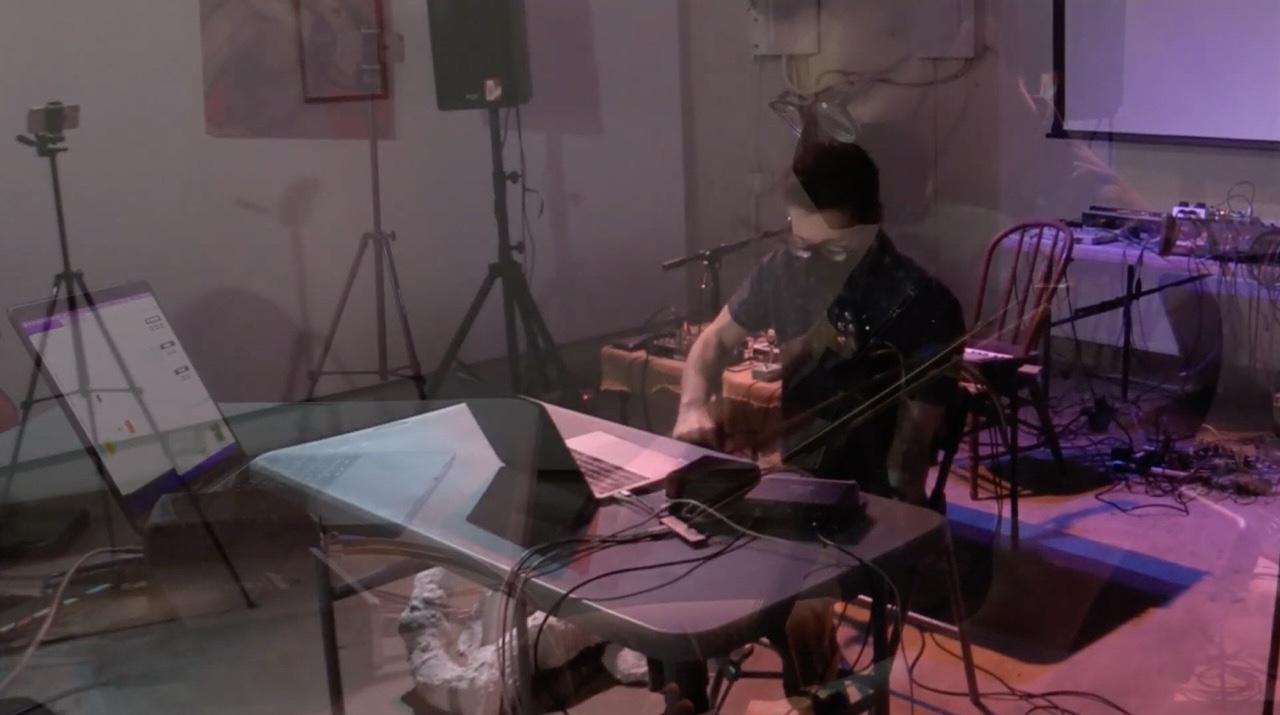
Live improvisation at The Bridge Art Gallery
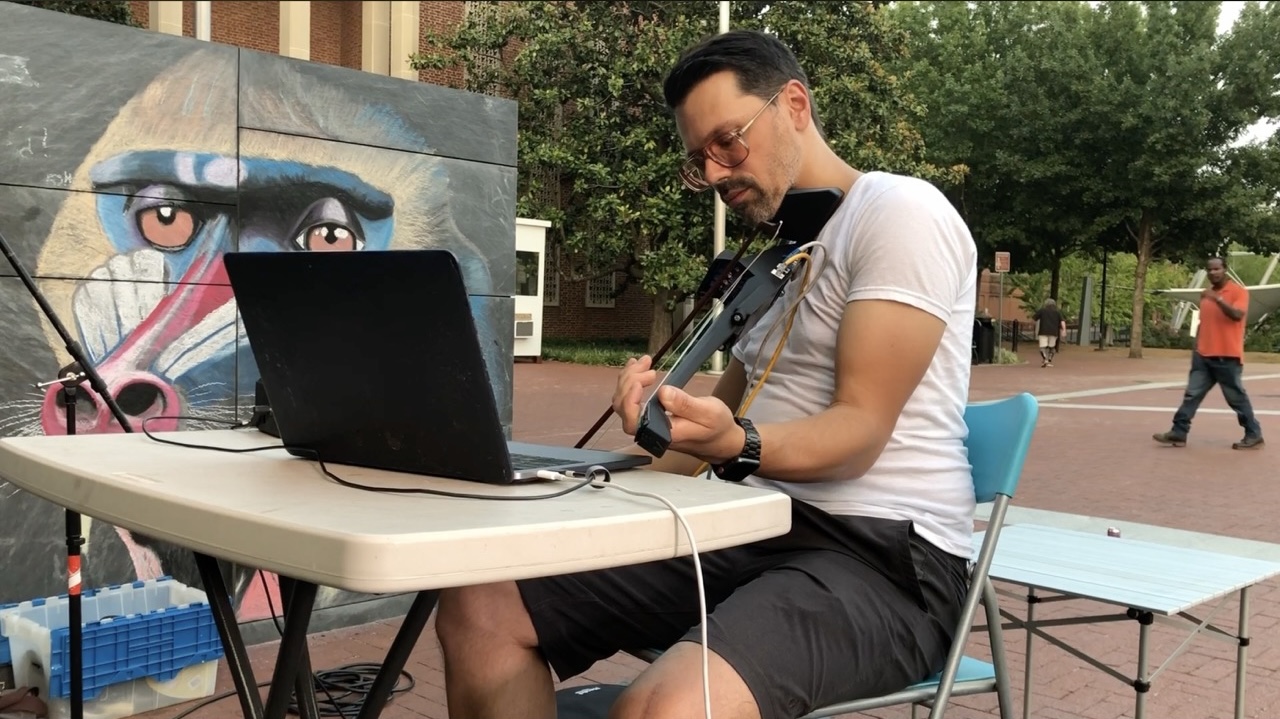
Live improvisation on the Downtown Mall
studio album composed with the EV
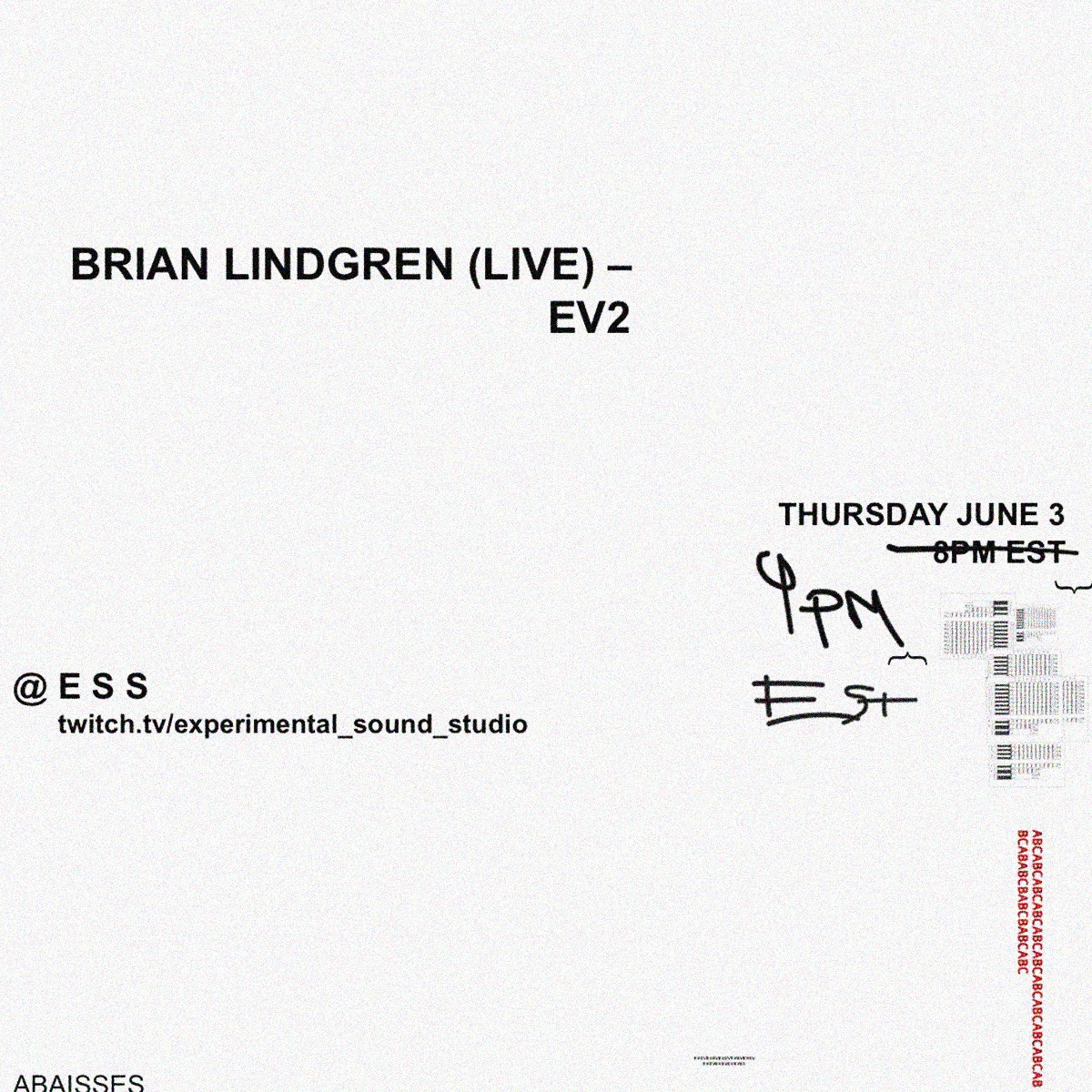
Live at the Experimental Sound Studio (The Quarantine Concerts) Chicago
studio album composed with the EV
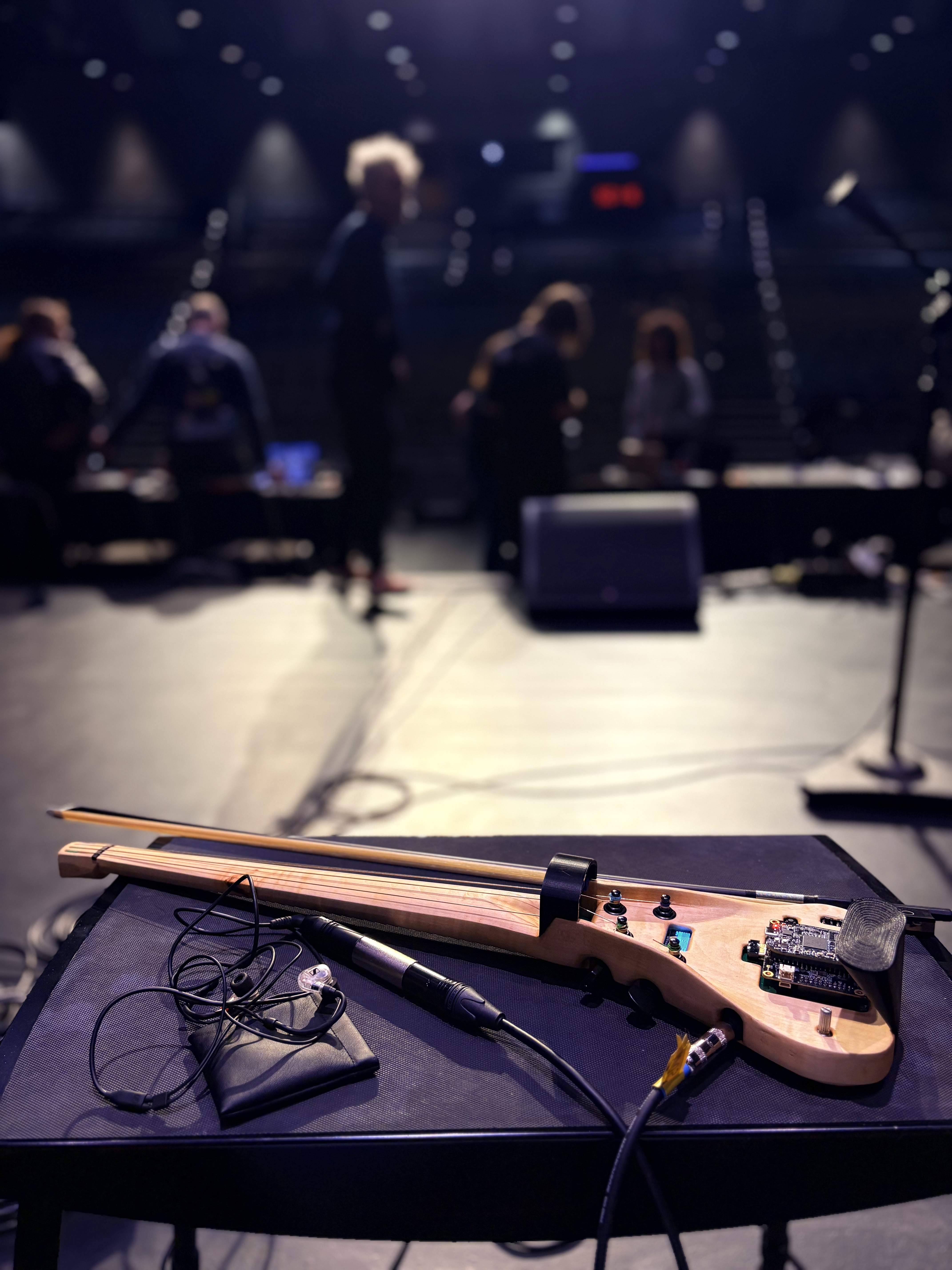
Georgia Tech, March 2026
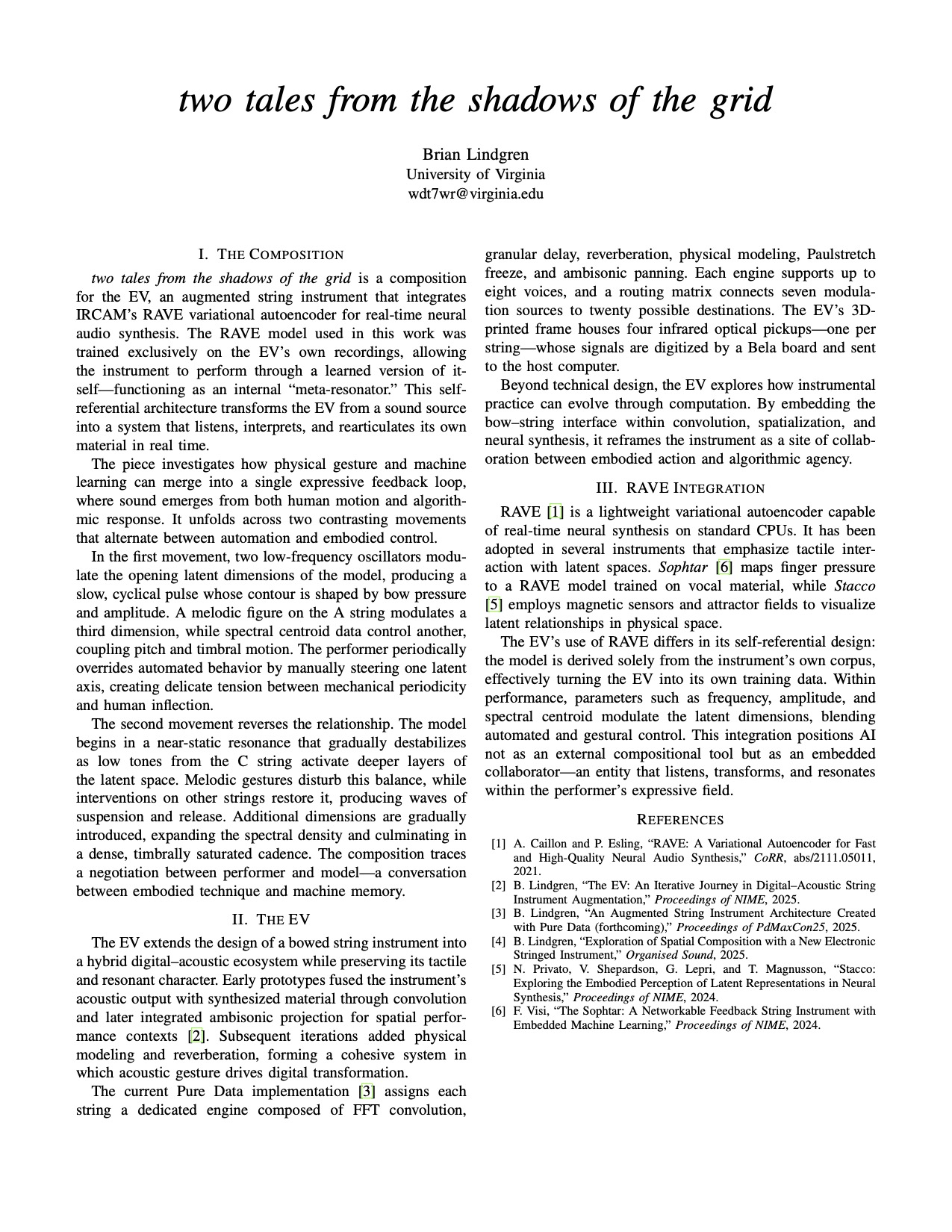
Program notes for entry into the IEEE Big Data 2025 3rd Workshop on AI Music Generation: AI Music Competition (AIMG 2025)
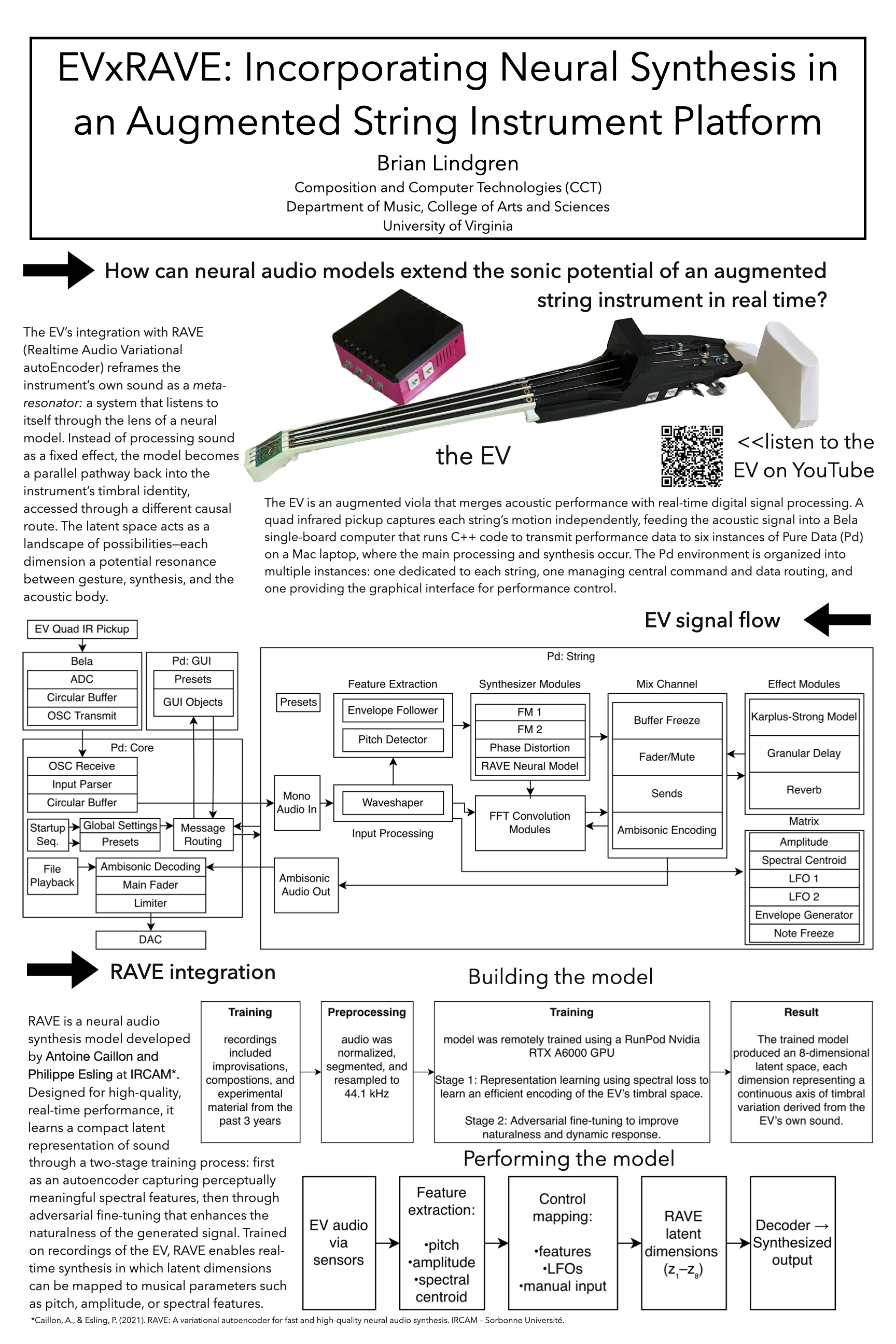
NeurIPS 2025 AI4Music Workshop Poster + Demo
Third and third-point-five iterations of the EV, featuring a CNC-cut curly maple body, embedded Bela single board computers, with extensive DSP capabilities, coded in C++.
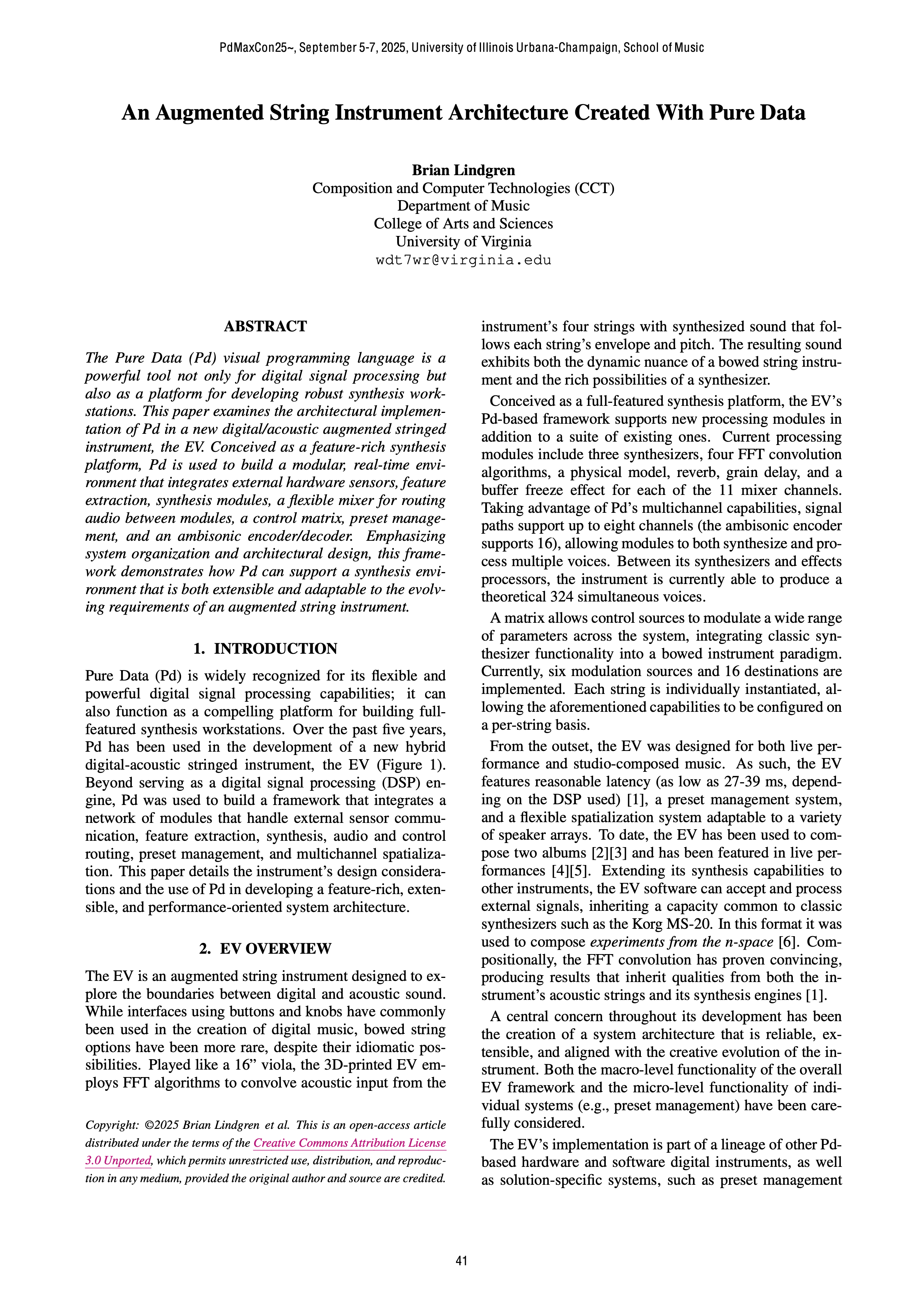
PdMaxCon25~, 2025
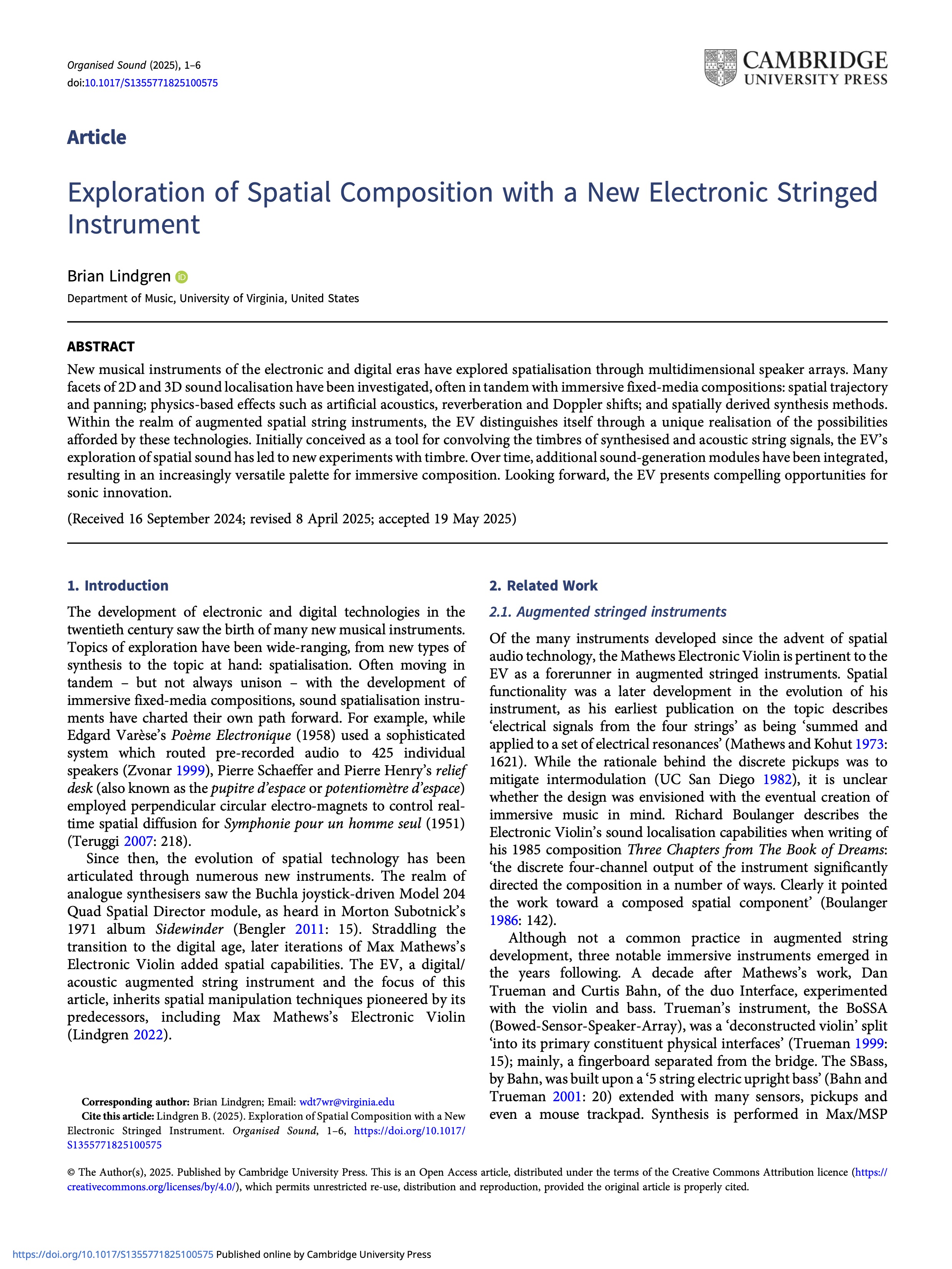
published in Organised Sound, vol. 30, no. 2, Sept. 2025
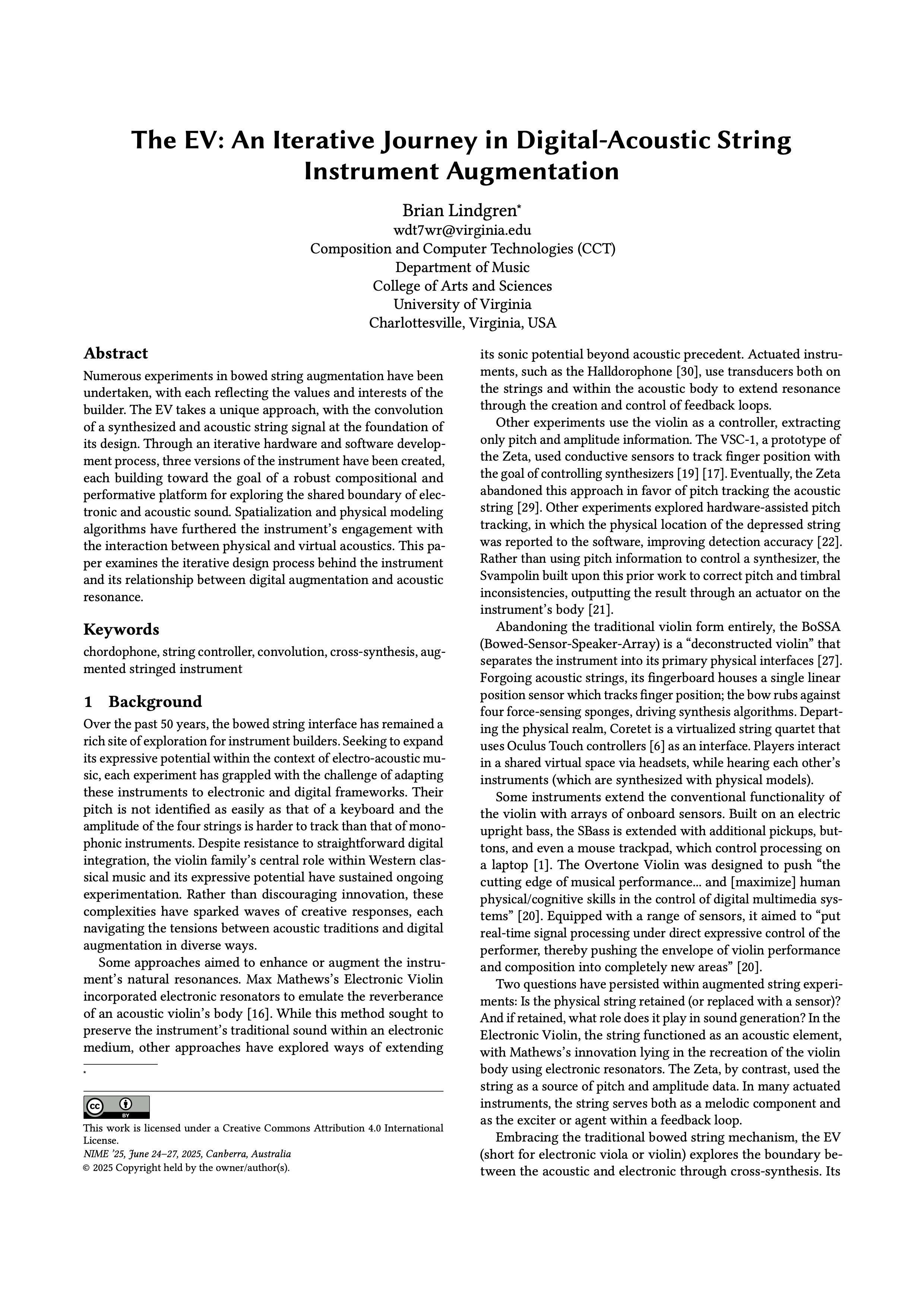
Presented at the New Interfaces for Musical Expression (NIME) conference 2025
Presented at the International Computer Music Conference (ICMC) 2025
NIME 2022
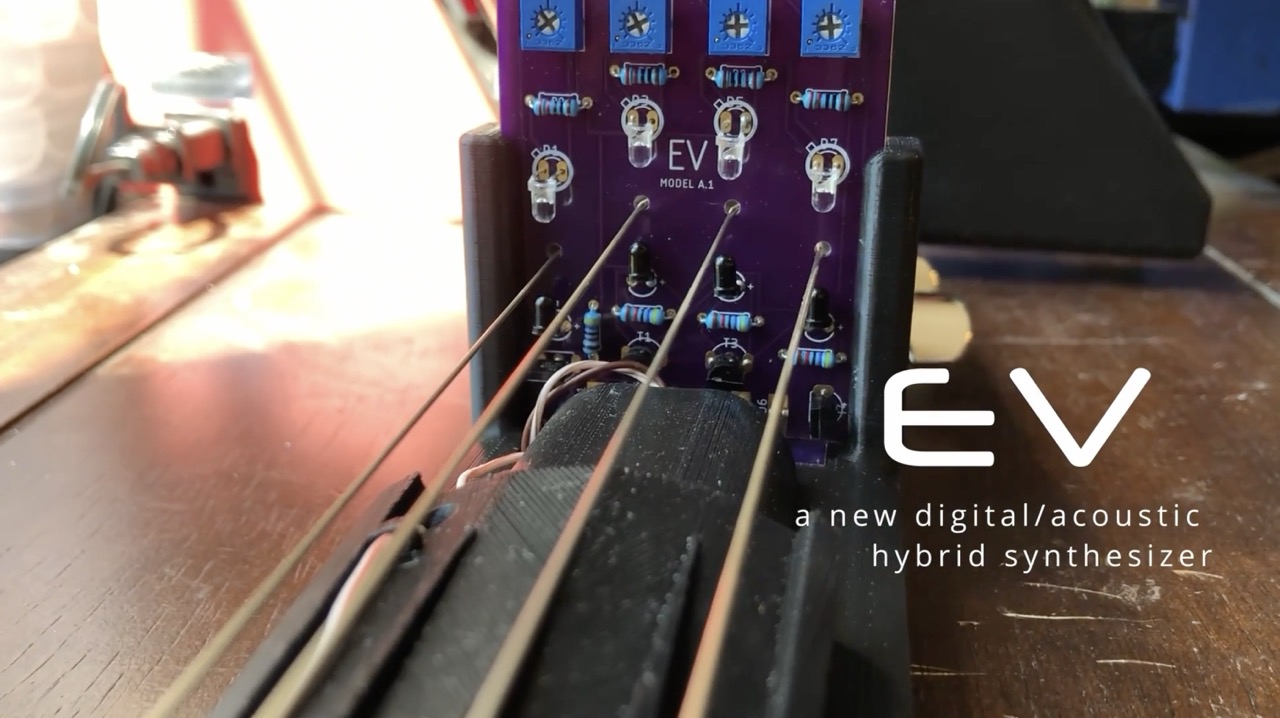
Guthman Musical Instrument Competition 2022 Semifinalist